
Spreadsheets are flexible, cheap and familiar, which is why most agencies run on them. The catch is that a spreadsheet is only as current as the last time someone updated it, and the logic behind it usually lives with whoever built it. Aria keeps capacity, budgets, time and margin in one live picture alongside your projects and pipeline. It spots what's slipping and recommends the next move while there's still time to act, and you decide what happens.
Aria is agency management and PSA software: a shared place to review recorded projects, time, costs and capacity, with forecasts and warnings to help you decide where to look.
Almost every agency starts out on spreadsheets, and plenty of good ones still run on them. A capacity sheet here, a budget tracker there and a pipeline tab someone added last spring. It works because the person who built it knows exactly how it all hangs together. If you're comparing agency spreadsheets vs software, this page sets out what spreadsheets do well, where they start to struggle as the work and the team grow and how Aria is different, so you can decide whether you've reached that point yet.
On this page
Aria and spreadsheets side by side
A spreadsheet can be built to do almost anything, so the left-hand column describes common agency use rather than its limits. The Aria column describes specific views and calculations built from recorded work, not a promise that nobody has to maintain the information.
| Area | Spreadsheets | Aria |
|---|---|---|
| Built to | Hold whatever you put in, laid out however suits you | Bring projects, people, time and money into one live picture and show what needs attention |
| Getting started | Someone builds the sheet, then copies the scope, budget and people across | Recorded projects, estimates and bookings together, so you can review delivery, capacity and forecast costs |
| Keeping it current | Someone updates it by hand, usually just before a meeting | Recorded time, estimates and bookings feed the views; connected activity updates in the background |
| Joining it up | A person cross-checks tabs and sheets, using formulas they wrote and maintain | Projects, people, time and costs can be reviewed together, with pipeline bookings included when configured |
| When that person is away | The sheet waits for them, or someone else tries to decode it | Saved project records remain available to people with access; the team still needs to keep the information useful |
| Capacity and margin | Usually in separate sheets, compared when someone has an hour spare | Seen together: Aria spots who's about to be overbooked and shows where budget, costs and margin are heading |
| Spotting problems | Whoever opens the sheet has to notice, often at month-end | Aria does the looking for you: it spots what's slipping, explains why and shows the knock-on effect while there's still time to act |
| Who decides | You do | You do. Aria recommends; the person accountable decides what happens next |
| Best for | Small teams with a few steady projects and someone with time to keep the sheet current | Agencies that would rather spend people's time on the work than on keeping the picture up to date |
What do spreadsheets do well for agencies?
Quite a lot, which is why they're so hard to give up. A spreadsheet costs nothing extra, everyone on the team can open one and it bends to fit the way your agency works, rather than the way a tool assumes it should.
That flexibility is real. You can track capacity by person and week, build a budget for a pitch, keep a list of risks for a tricky client and add a pipeline tab when sales asks for one, all without learning new software or waiting for anyone's sign-off. For an agency with a handful of people and a few projects, it's often the right tool.
A good spreadsheet also says something about the person who built it. Someone cared enough about the numbers to put them somewhere and keep them tidy. Most agencies have at least one sheet like that, and one person everyone relies on to keep it up to date.
Where do agency spreadsheets stop working?
Usually not in one dramatic moment. They stop working gradually, as the time it takes a person to keep them right grows faster than the agency does. Every new project adds rows, every new person adds a column and every new client adds a tab, and all of it still has to be updated, checked and joined up by hand.
Three things tend to give first:
- They fall behind. A spreadsheet only changes when someone changes it. Time gets logged on Friday, the budget gets updated at month-end and the capacity sheet gets refreshed just before the resourcing meeting. In between, the work moves on and the sheet doesn't.
- They sit apart. Capacity is in one sheet, budgets and margin in another and the pipeline in a third. Each can be right on its own terms, but seeing what new work does to who's free, and what that does to margin, means someone sitting down to compare them.
- They live in someone's head. The formulas make sense to the person who wrote them. Which tab is current, which columns to ignore and why one project is shaded orange is usually known by one or two people.
Put together, that's a good part of somebody's week. The hours go on keeping the picture up to date rather than acting on it, and they usually belong to the people an agency can least spare: a project manager, an operations lead or the founder.
That last one matters more than it sounds. When The Wow Company asked owners of UK agencies with £1m+ fee income what would happen over three years if they stepped away, 48% said the business would shrink or close (The Wow Company, 2026). That's owners' own view of their business rather than a measure of it, but it says a lot about where the picture tends to live.
Michael Gold, our CEO and co-founder, describes this as one of the three ways agencies handle delivery today: the project tool, the spreadsheet and the one person who holds it all in their head. It holds up well until that person is busy, off sick or on holiday.
What does a spreadsheet-run agency look like in each role?
The same spreadsheet looks different depending on whose time it's taking. A few versions most agencies will recognise:
- Founders and CEOs
- the budget and margin sheet is updated once a month, so whether a project made money is something you find out at the invoice rather than while it's running. Read more in Why your agency has the information but still misses the warning signs.
- Heads of Delivery
- status sits in a RAG column that someone fills in before the weekly meeting, and it's out of date by the time it's read. Read more in Why 'the client told us first' keeps happening.
- Operations
- the agency capacity planning spreadsheet is refreshed before the resourcing meeting, so it shows how busy people were rather than where capacity is about to run out, and the pipeline is somewhere else again. Read more in Pipeline belongs next to capacity, not a separate spreadsheet.
- Finance leaders
- reconciliation spreadsheets bridge delivery and finance. They're often the most carefully kept files in the business, but they can only reconcile what's been recorded, so utilisation and margin are worked out after the fact. Read more in The difference between a forecast and a guess.
- Project managers
- the RAID log (risks, assumptions, issues and dependencies) is updated line by line, and keeping it current alongside the status report takes time that should go on the client and the team. Read more in Why timesheets feel like surveillance.
None of this is anyone doing their job badly. It's good people spending their hours keeping a picture current by hand, because nothing else will.
How is Aria different from a spreadsheet?
Aria gives you a shared place to review capacity, budgets, time and margin. Calculations use what is recorded, so you can compare costs and bookings without rebuilding that calculation in another tab. People still need to log time and keep plans useful.
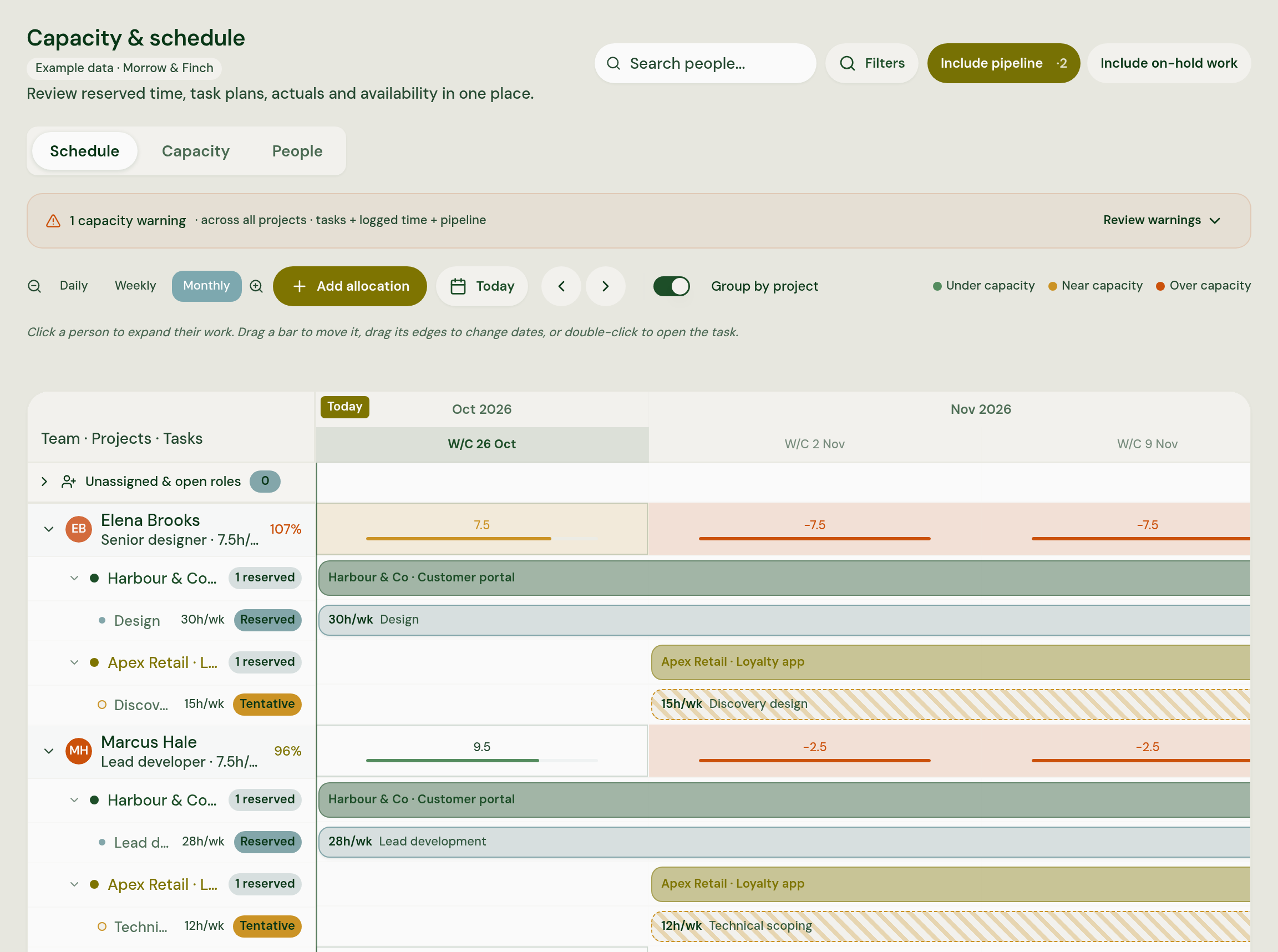
Booked work, estimates, logged time and approved expenses feed the picture. Connected calendars and meeting records add context through background updates. You can see overbooking warnings and where forecast costs or margin are heading, then check what that means for the plan.
Then Aria does the looking for you. It spots what's slipping, explains why and shows the knock-on effect for delivery, people and margin, and it recommends the next move while there's still time to make it.
The judgement stays with you. Aria's forecasts and warnings give you things to check, and recommendations are options to consider. People still need to record the work and decide what gets changed or said to the client.
Right now, when you decide to switch, our team will move your spreadsheets into Aria for free.
When is a spreadsheet enough?
When the picture is small enough for one person to hold, and that person has the time to keep it current. A spreadsheet is a sensible choice if:
- you're a small team with a handful of projects, and most people can see most of the work most of the time
- your work is fairly steady from week to week, so the sheet doesn't need changing every day
- someone has time set aside to update it, as part of their job rather than something squeezed in after hours
- new work arrives slowly enough that pipeline and capacity rarely collide
That's a perfectly good way to run a small agency. The trouble comes with growth, and it creeps in quietly. More projects mean more rows to update, more people mean more weeks to plan and more clients mean more tabs to check, so the hours it takes to keep the sheet right keep climbing. At some point the person maintaining it spends more time on the spreadsheet than on what it's telling them.
When the person who maintains a spreadsheet is away, it helps if the team knows where the records are and what needs updating. Software can give them a shared place to work, but somebody still needs to keep time, estimates and bookings useful. That ownership matters whichever tool you choose.
What should you look for in resource management software for agencies?
Whatever you move to should take work off people, not add a new kind of upkeep. Most resource management software for agencies will let you plan who works on what. The useful questions are about who keeps it running. These are the ones we'd ask in any demo, including ours:
- Who has to update it? If the answer is still someone, by hand, before a meeting, you've moved the spreadsheet rather than replaced it.
- Does it start from what you already have? Setting up every project from scratch takes the same hours you're trying to free up.
- Can you see pipeline next to the people who'd deliver it? Planning capacity without the work that's about to land only tells you half the story. Michael Gold makes the case in Pipeline belongs next to capacity, not a separate spreadsheet.
- What happens when the person who runs it is away? If everything waits for them, not much has changed.
- Does the decision stay with you? Software can spot problems and recommend what to do. Your team should still make the call.
If we had to pick one test, it would be the first. Count the hours someone spends keeping today's picture right, then ask how much of that the new tool takes off them.
What about PSA software or a fractional COO?
Moving off spreadsheets involves both the tools you use and the people leading delivery. PSA software connects projects, people, time and money; a delivery lead, COO or consultant helps the agency put it to work. They often introduce and manage the software, lead adoption and change, and support the people managing and delivering client work. Aria gives them a clearer picture and less admin, with more time to lead. Depending on your agency's size and circumstances, experienced delivery leadership, including fractional support, can be hugely valuable alongside the software. Read more in PSA software and Aria vs a fractional COO or delivery consultant, or explore our compare page.