Aria for CFOs and finance directors

A current view of margin and utilisation, built from numbers you can trust
Aria connects projects, people, time and money, with your sales pipeline alongside. See project margins and forecast costs as work progresses, spot where the information is incomplete and bring more useful context to decisions about pricing, capacity and growth. Your financial judgement stays yours.
14 days to explore Aria · No credit card required

What changes for a finance leader
See which engagements are making money, and where extra effort may be changing the economics
Distinguish recorded costs from future estimates, including what has not yet been measured
Bring delivery reality into hiring, pricing and growth discussions before decisions become expensive to reverse
As the business grows, finance's questions change

When finance is part of several people's jobs
You may be the founder, an external accountant or a fractional finance lead. The first challenge is knowing what each client or project actually costs to deliver, without another spreadsheet to keep alive.

When you are weighing growth against the cost base
You have more projects and a larger team. The questions become harder: which work is worth winning, whether capacity is genuinely tight and whether recruitment would help the business financially.
When finance covers several teams or practices
Different leaders bring different delivery forecasts. You need to see where assumptions diverge and which changes matter for the wider plan, without pretending a project view replaces your company forecast.
Different remits, same need: financial decisions built on a clearer understanding of the work behind the numbers.
Sound familiar?

Revenue is holding up, but the margin keeps getting smaller
That fixed-fee project needed another week. A retainer client has asked for a few extras, again. The fees look fine, but the time and outside help required to earn them are creeping up.

The forecast looks unchanged, even though delivery has moved on
Someone has extended an engagement, moved a milestone or booked in a specialist. The project team knows. Finance hears about it at the next review, when the original forecast has already stopped reflecting the plan.

You're being asked to stand behind numbers with gaps underneath
A margin is shown to one decimal place, but some hours are missing and nobody has updated the estimate for the work left. The figure looks precise; explaining how far to trust it is another matter.
The common problem is not a lack of financial discipline. It is that the work changing your forecast happens across project teams, time records and commercial conversations before it reaches finance.
A clearer view of what delivery means financially
Aria is agency management and PSA software for agencies and consultancy firms. It helps finance leaders examine the recorded work, cost assumptions and resource commitments behind commercial performance.
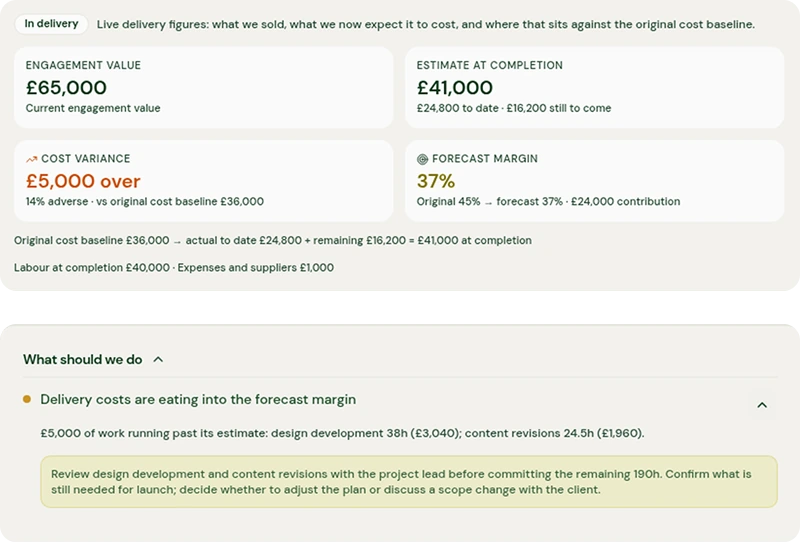
The client is happy. Is the work still paying its way?
Extra rounds of revisions and unplanned specialist hours can quietly change the cost of a fixed-fee project or retainer. Aria's margin-to-date view uses recorded project revenue, time and approved expenses. Forecast costs also consider estimates and bookings for work still to be done, so the conversation can happen before the final invoice.
When the client agrees a change, approving it in Aria updates the scope, budget and dates together. Where agreed scope is recorded, Aria can flag potential additions for a person to review against the client agreement. It does not decide whether the work is chargeable or automatically calculate whole-client lifetime profitability.
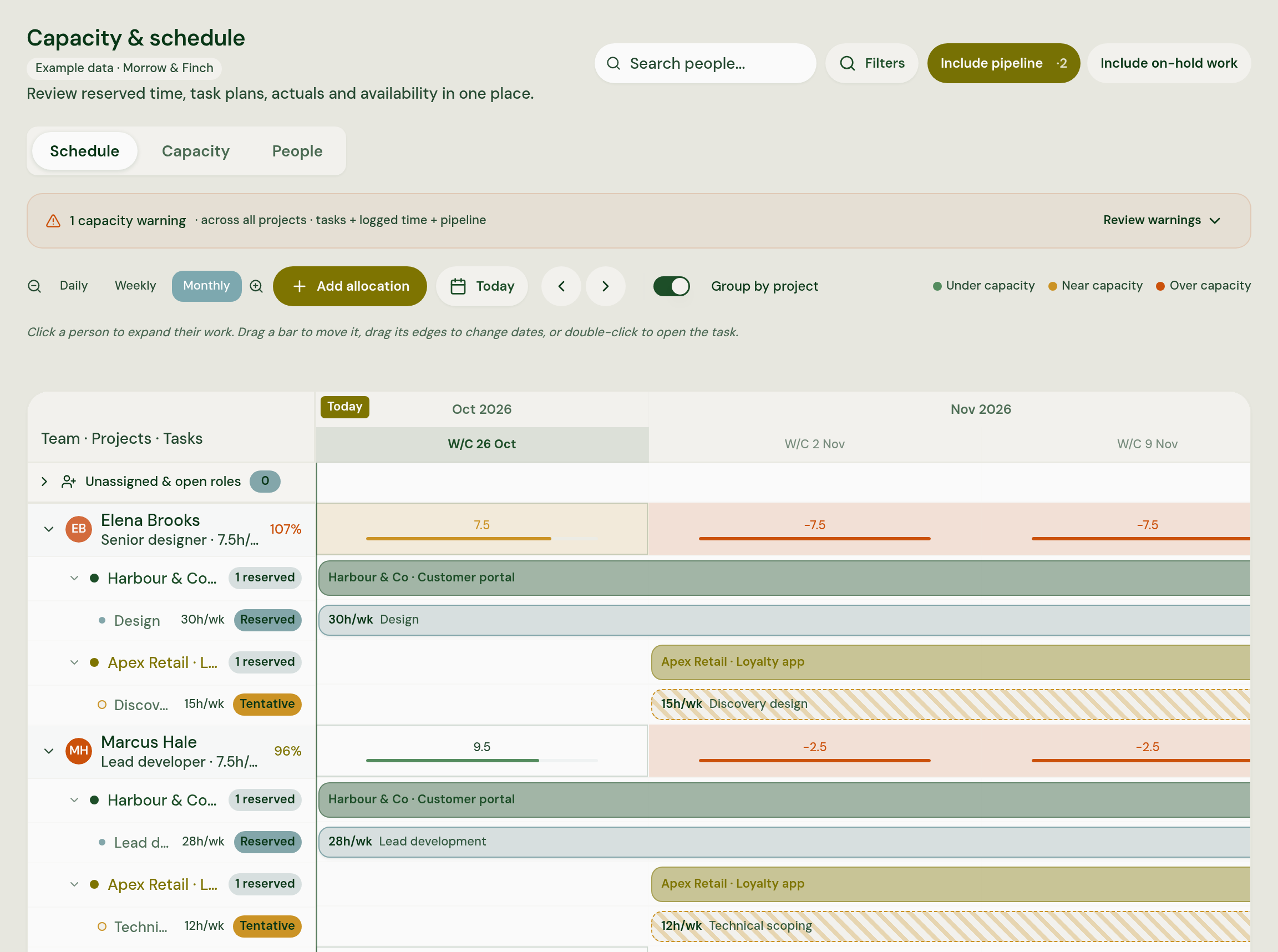
Three specialists would help us grow. Are they the right investment?
The pipeline looks promising, but adding permanent costs on the strength of potential work is a real decision. Aria shows existing bookings and available capacity; draft projects with linked tentative bookings can appear alongside confirmed commitments using Include pipeline. The schedule shows proposed bookings in full, while certain portfolio views may weight opportunities by likelihood.
That lets you question the demand and look for suitable capacity before committing to recruitment or contractors. Aria does not model payroll, calculate a hiring business case or approve the spend.
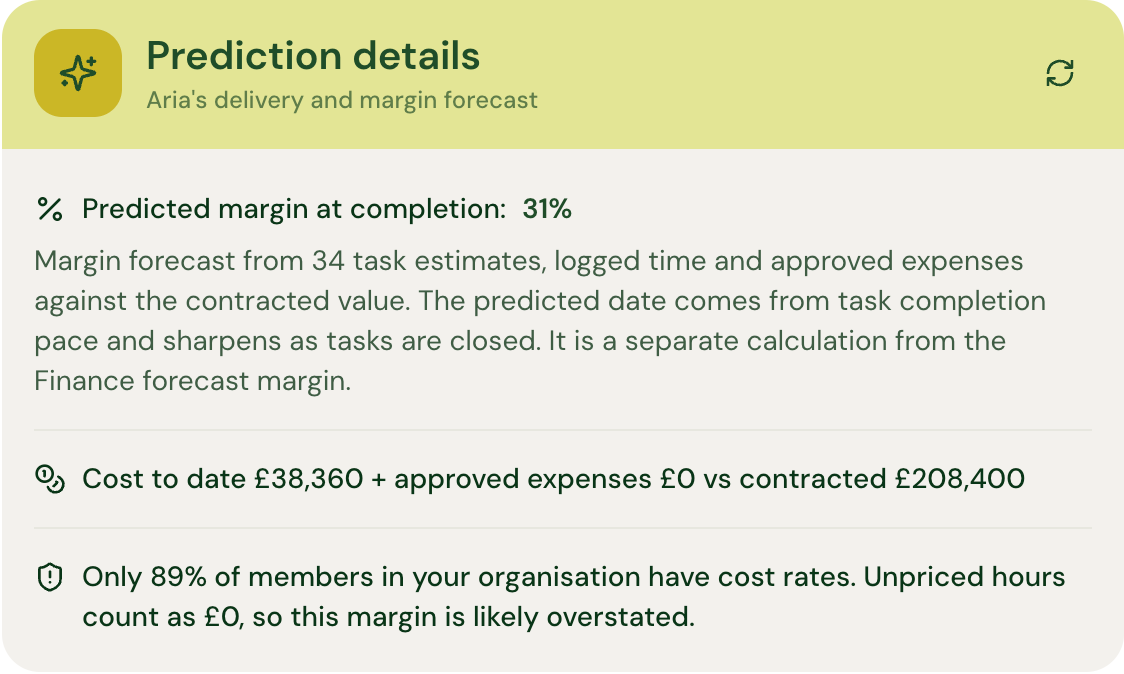
The forecast looks reassuring. What is it actually based on?
If rates, commercial terms or estimates are missing, a confident-looking margin can be misleading. Aria can flag gaps and mark margin as not measurable with an explanation when the inputs cannot support a figure. Delivery-confidence signals are separate: apparent progress is not proof that every cost has been captured.
A milestone delay may affect invoicing or collection timing under the contract, but Aria does not automatically forecast cash receipts from that delay. It gives finance and delivery a clearer issue to investigate and decide how the financial plan should change.
The features that matter when you run finance
The useful detail is not another list of numbers. It is knowing what has been recorded, what is still expected and where delivery choices might change the commercial result.

Project financials and margin
Review project revenue, recorded effort and approved expenses against margin to date, with forecast costs for the work remaining.

Forecast gaps and not-measurable states
See where missing rates, commercial inputs or estimates weaken the project picture instead of treating every figure as equally dependable.

Resource planning and utilisation
Look at booked hours and available capacity across teams before discussing contractor spend, recruitment or a change in commitments.

Time and expenses
Keep effort and approved expenses connected to the work that generated them, helping finance understand which costs have actually been captured.

Sales pipeline and proposed work
Review tentative bookings from linked draft projects alongside existing work, rather than considering the next client in isolation.

AI insights and Aria Assistant
Ask practical questions about project costs, budgets or risks and see supporting context. Financial values come from calculations and recorded information, not invented AI figures.
Keep the systems your teams already use
A stronger connection between finance and delivery should not mean replacing the accounting system that does its job well. Aria integrates with Xero and Salesforce, as well as GitHub, Gmail, Google Calendar, Outlook, Outlook Calendar and Fireflies.ai, bringing supported finance, sales, development and everyday work context closer to the projects behind it.
What moves through each integration depends on the connection, configuration and permissions. That is not a promise of instant two-way synchronisation, automatic reconciliation, a complete general ledger or access to every record. The value is making the right operating context easier to examine alongside the finance team's own systems.

We're always adding integrations. If there's a finance or delivery tool your team relies on that Aria doesn't yet connect with, tell us what you would like to see.
The financial judgement stays with you
Aria helps make recorded project costs, remaining-work assumptions and delivery risks easier to examine. Its financial maths is calculated from available records rather than generated by a language model. If a margin cannot be supported, the answer should be 'not measurable', not an invented percentage.
Your team still decides which assumptions to change, what to report to the board, whether to challenge a client request and whether additional capacity is worth its cost. Aria is not your accounting ledger, payroll engine or a replacement for a cash-flow model; nor does it independently reassign staff or contact clients because a warning appeared.
The numbers behind it
These findings describe different aspects of the finance challenge: trusting the data, protecting profitability and deciding what to do with costly capacity.
37% of CFOs did not completely trust their financial data
In a 2024 BlackLine-commissioned Censuswide survey, 37% of CFOs reported incomplete trust in the accuracy of their organisation's financial data; 50% of senior finance and accounting professionals said the same. The 1,339 respondents came from seven countries and companies larger than most Aria prospects. It is not a measure of UK agency data quality.
43% average gross profit at UK agencies with over £1m in fee income
BenchPress 2026 reported 43% average gross profit in 2025 among UK agencies in its £1m+ fee-income group, and 14% average operating profit. These are different profitability measures and an industry benchmark, not a gain Aria promises to deliver.
66.4% average billable utilisation across surveyed professional services firms
SPI Research's 2026 benchmark recorded 66.4% billable utilisation in 2025 across its global professional-services survey, alongside 37.7% average project margin. They describe the surveyed firms, not a target or expected result for every consultancy.
Sources: BlackLine/Censuswide, 30 January 2024; The Wow Company, BenchPress 2026, UK agencies with £1m+ fee income; SPI Research, Professional Services Maturity Benchmark 2026 (509 organisations worldwide). External figures, not Aria customer outcomes.
Aria versus what you use now
You may already have an excellent accounting system, a competent delivery team and a carefully maintained financial model. The difficulty is often keeping the operating assumptions behind those numbers current enough to make a decision.
| Finance question | Today, across separate tools | With Aria |
|---|---|---|
| What is the project costing us? | Ask for late timesheets, reconcile approved expenses and rebuild the project view | Review margin to date from recorded revenue, time and approved expenses |
| Where are forecast costs heading? | Carry forward the original estimate until the next delivery review | Consider the remaining estimates and bookings alongside costs already recorded |
| Can we trust this figure? | Investigate blank rates and unestimated work when someone queries the report | See missing inputs and a not-measurable explanation where margin cannot be supported |
| Are we pricing the extra work? | Notice the hours after an informal client request has already grown | Review potential additions flagged against recorded agreed scope; people decide what is billable |
| Should we add capacity? | Compare pipeline, booked people and spreadsheet scenarios separately | Review confirmed capacity alongside linked tentative pipeline bookings |
| Could a milestone change affect cash? | Check contractual billing triggers and financial plans after the delivery change | See delivery progress and risk context; finance still models and decides any cash consequence |
| Who signs off the commercial call? | Your finance and business leaders | Your finance and business leaders; Aria does not approve expenditure or invoices on their behalf |
Still comparing tools? Explore Aria versus spreadsheets, or what agency management and PSA software adds alongside accounting and project software.
Better for the people behind the numbers, too
Finance can't keep the forecast current alone. It works better when the people closest to delivery have somewhere useful to record the work, check commitments and explain changes as they happen.
For founders and managing directors
See whether profitable growth assumptions are holding up, with a clearer project and capacity picture to discuss with finance.
See Aria for founders and CEOsFor COOs and operations leaders
Explore how planned capacity, upcoming work and resource trade-offs connect to the cost decisions you are weighing.
See Aria for COOs and operations leadsFor Heads of Delivery
Use project plans, time records and risk context as part of running the work, rather than recreating a finance report from memory.
See Aria for Heads of DeliveryFor project managers
Use project plans, time records and risk context as part of running the work, rather than recreating a finance report from memory.
See Aria for project managersFor your accounting and finance colleagues
Work from clearer project-level inputs while keeping accounting, statutory reporting and cash management in the systems responsible for them.
Common questions
See what Aria could change for your financial picture
Bring a project margin you want to challenge, a forecast built on patchy delivery inputs or the hiring decision that needs a better look at capacity. We'll show you the relevant Aria screens, what the numbers include and where they stop.
14 days to explore Aria · No credit card required · Cancel anytime
Read more
A forecast built on estimates rather than what's actually happening in delivery only shows its gaps once the quarter has closed. This piece looks at why delivery numbers and finance numbers so often disagree, and what it takes to report margin by project with figures you'd be happy to defend.
Michael Gold · · 12 min read
Finance leadersForecastingMargin and profitabilityWhen a project goes wrong, the warning signs have usually been there for weeks, spread across different tools and only joined up when someone pulls a status report together by hand. Michael Gold explains why that keeps happening, and why even good delivery tools rarely make it easy to see what needs attention while there's still time to act. You'll also find out what it means for your role, and where to go next if you want to get into the detail.
Michael Gold · · 12 min read
Founders and CEOsHeads of DeliveryOperationsFinance leadersProject managersDelivery consultantsDelivery teamsMargin and profitabilityStatus and reportingUK agency profit margins, project overruns, status reporting and more, each with its source, its sample and what to bear in mind before you quote it
· 20 min read
Founders and CEOsHeads of DeliveryOperationsFinance leadersProject managersDelivery consultantsDelivery teamsMargin and profitabilityStatus and reportingCapacity planningForecastingTimesheets and AI