Aria for Heads of Delivery

Know which projects need attention, why and what to do next
Aria brings projects, people, time and money into one picture across your portfolio. See which commitments need attention, understand the pressure on shared people and review the costs behind the plan, while there’s still time to decide what changes next.
14 days to explore Aria · No credit card required

How Aria helps Heads of Delivery
Spot delivery risks behind reassuring green statuses.
Check who is committed elsewhere before moving someone to recover a project.
Give PMs a clearer starting point for discussing delivery risk before the client notices it.
The remit grows beyond your own projects

When you are still close to every project
You may be the lead PM as well as the delivery lead. The useful picture is one that helps you coordinate the next handover and client decision without spending the morning collecting updates.

When several PMs share the same specialists
A developer, designer or consultant can be critical to more than one commitment. Each PM has a good reason for needing them; you need to understand what happens across the portfolio when one plan moves.
When you inherit several teams or practices
The projects come with different reporting habits and different versions of “on track”. You need enough common context to know where to intervene, where to coach and which questions cannot wait for the next review.
Sound familiar
One project is recovered by putting another under pressure
A senior developer stays an extra week to finish an integration. That solves today’s problem, but they were due to start somewhere else on Monday. The second client’s deadline has not moved with them.

The deadline survives because the team absorbs the extra work
Another round of revisions is squeezed in, a freelancer helps out and the delivery date stays green. The extra hours and cost tell a less comfortable story.

You hear the problem in the client’s words first
The weekly report looked fine. Then a client asks why a milestone has moved or why the same deliverable has come back again, and you have to rebuild the situation before you can respond.
These are connected delivery decisions. A change to scope or timing affects people, cost and other commitments, even when each project has its own perfectly reasonable plan.
Know where to intervene and what else to check
Aria is agency management and PSA software for agencies and consultancy firms. It brings project plans, recorded effort, capacity and financial context together so you can examine a delivery problem beyond its latest status.
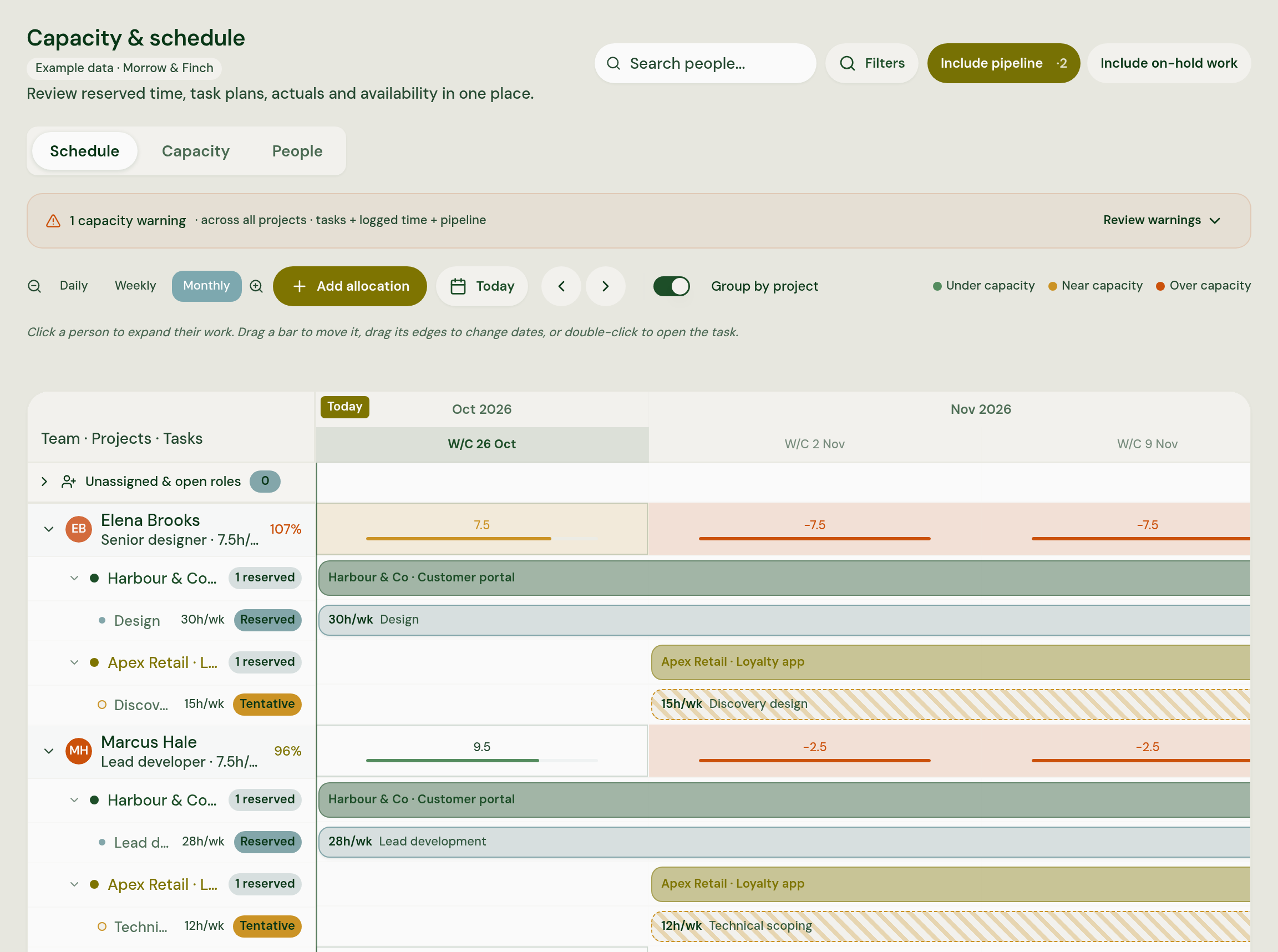
The project needs help but who can actually give it
Review booked hours and available capacity alongside the projects that need the same people. Overbooking warnings appear in scheduling and assignment views, giving you somewhere to start the resourcing discussion before another deadline inherits the problem.
Aria Assistant can help you explore capacity questions in plain English. You still decide whether to move an assignment, add outside help or change a commitment; the view is evidence for that decision, not an automatic recovery plan.
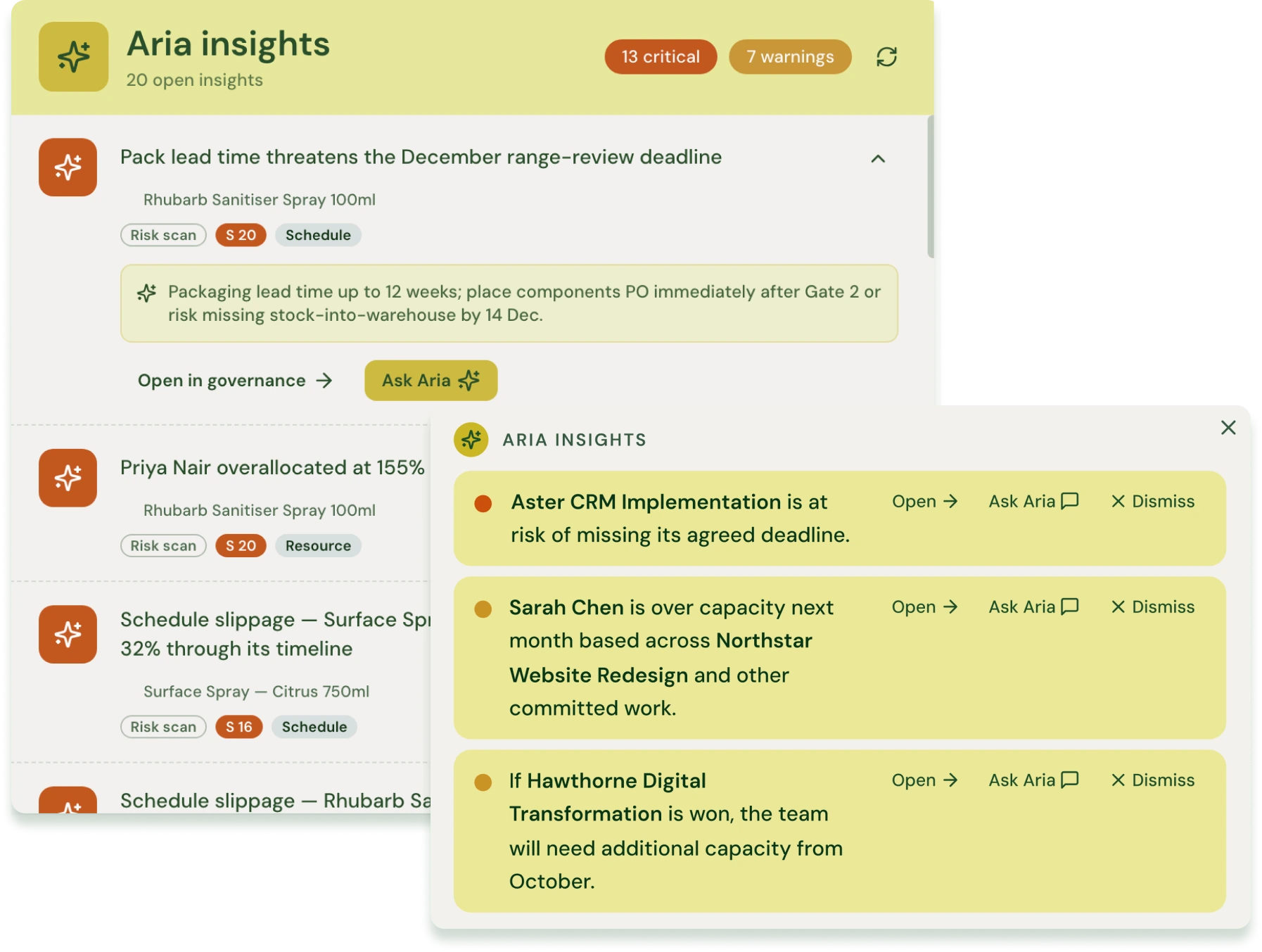
The status says healthy but what is behind it
Work at risk highlights dated or dependent tasks where the recorded plan shows a risk of slipping. Calculated project health uses progress, overdue work, budget use and forecast margin, with an explanation alongside it. A manually set status can override the calculation, so check which one you are reading.
Use the explanation to decide what needs investigation and who should be involved. A score does not tell you whether creative work is good, whether an implementation will pass testing or whether a client will accept the result.
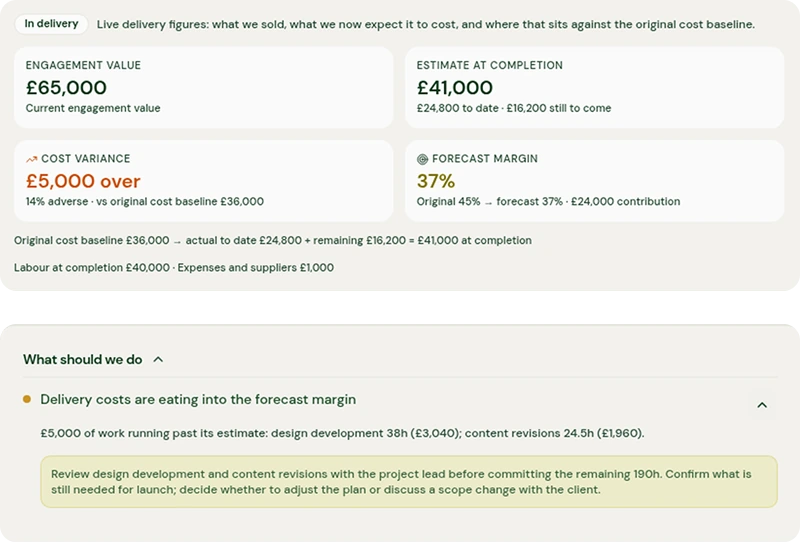
The work is being delivered but is the extra effort visible
Start from the Statement of Work you sold: Aria proposes a delivery plan from it for you to review, and when the client agrees a change, approving it updates the scope, budget and dates together. Bring logged hours, project budgets and financial information into the same conversation as milestones and tasks. Where agreed scope is recorded, potential additions can be flagged for review. Your team still checks the client agreement and decides what needs pricing, replanning or a conversation.
The aim is to understand whether the commitment is being met in a sustainable way, rather than letting a delivery date hide the hours being absorbed around it.
The tools that matter across a portfolio

Projects and portfolio
Review tasks, milestones, logged hours and budgets across client projects without rebuilding every view from separate updates.

Work at risk and project health
Examine dated or dependent work at risk of slipping, with the calculated health explanation and any manual status distinguished.

Resource planning and capacity
See existing bookings and available hours before discussing a recovery that relies on someone already needed elsewhere.

Project financials
Review recorded effort and financial context alongside the delivery plan, including where the information is incomplete.

Time and status assistance
Give PMs a status draft to review and teams suggested time entries to check, rather than another blank report to complete.

Client portal
Share selected tasks, milestones and progress with clients. Keep control of what is shared and the conversations that need a person.
Keep useful context close to the work
Aria connects with Gmail, Google Calendar, Outlook, Outlook Calendar and Fireflies.ai. Supported calendar and meeting records can add context through background updates, alongside the plans and hours your team records.
What each connection contributes depends on its permissions and configuration. Connected activity helps you investigate; it does not make every message visible across the business or guarantee that every change reaches every view instantly.

The delivery call stays with you
You decide whether a warning is material, which commitment to change and what the client needs to hear. Aria can highlight a concern and suggest a next move, but it does not independently reassign staff, contact clients or make commercial decisions.
The client portal shows the information you share. Check its status and permissions rather than assuming internal concerns are automatically private. Aria does not collect keystrokes, screenshots or browsing activity to judge how hard the team is working.
The numbers behind the delivery pressure
81% say projects have become more complex
PMI’s Pulse of the Profession 2026 found that 81% of surveyed project professionals said complexity had increased in recent years. It describes respondents’ experience across countries and industries, not the proportion of agency projects failing. (Project Management Institute, 2026)
73.8% average on-time project delivery
SPI Research’s 2026 benchmark reported average on-time delivery of 73.8% in 2025 across its surveyed professional services organisations. This is a global, cross-firm benchmark, not a prediction for your portfolio or proof of a software benefit. (SPI Research, 2026)
72% spend at least half a day a month collating status reports
Wellingtone’s 2026 research found that 72% of project professionals spent at least half a day a month manually collating status reports; 44% were dissatisfied with their PMO’s reporting. The global research covers multiple industries, rather than UK agencies alone. (Wellingtone, 2026)
These studies describe different pressures on delivery. None measures results achieved with Aria.
Aria versus what you use now
Most delivery leaders already have agency tools and reporting routines that work because people put the hours into them. Here is the information those routines often have to join up.
| Delivery question | Across separate tools | With Aria |
|---|---|---|
| Which commitments need attention | Compare PM updates and reconcile different RAG judgements | Review recorded project context, work at risk and the health explanation |
| What happens if we move this person | Check other project plans and a separate resource sheet | Inspect existing bookings and available capacity before changing assignments |
| Are we absorbing extra work | Gather hours and costs after the deadline discussion | Examine logged effort and financial context alongside the plan |
| What does the client see | Rebuild an update and check it against the latest work | Share selected tasks, milestones and progress; people decide what to communicate |
| Who makes the recovery decision | Delivery leadership and the people accountable for the work | The same people, with more connected context to examine |
Better support for the people delivering it
For your PMs
A draft update, recorded project context and clearer risk explanations give them a starting point for their own judgement. The purpose is to support the conversation, not add another round of reporting to you.
See Aria for project managersFor the team
Suggested time entries can make the record easier to maintain. Visible bookings give the people planning work a way to discuss pressure before it becomes another late finish.
See Aria for delivery teamsFor operations leaders
The delivery discussion can include capacity commitments, recorded costs and missing inputs, so decisions about the portfolio are grounded in the same work.
See Aria for COOs and operations leadsFor finance leaders
The delivery discussion can include capacity commitments, recorded costs and missing inputs, so decisions about the portfolio are grounded in the same work.
See Aria for CFOs and finance leadersCommon questions
Bring us the portfolio decision you need to make
One slipping project, three competing commitments or a delivery date being held together by extra hours: bring the situation you are working through. We will show you the relevant Aria views and the questions they help you ask.
14 days to explore Aria · No credit card required · Cancel anytime
Read more
When status is rebuilt by hand once a week, anything that changes in between stays invisible until the next report. Clients see the work every day, which is why they so often notice the drift first. Here's why it happens and how to spot delivery risk before a client raises it.
Michael Gold · · 12 min read
Heads of DeliveryStatus and reportingClient relationshipsWhen a project goes wrong, the warning signs have usually been there for weeks, spread across different tools and only joined up when someone pulls a status report together by hand. Michael Gold explains why that keeps happening, and why even good delivery tools rarely make it easy to see what needs attention while there's still time to act. You'll also find out what it means for your role, and where to go next if you want to get into the detail.
Michael Gold · · 12 min read
Founders and CEOsHeads of DeliveryOperationsFinance leadersProject managersDelivery consultantsDelivery teamsMargin and profitabilityStatus and reportingUK agency profit margins, project overruns, status reporting and more, each with its source, its sample and what to bear in mind before you quote it
· 20 min read
Founders and CEOsHeads of DeliveryOperationsFinance leadersProject managersDelivery consultantsDelivery teamsMargin and profitabilityStatus and reportingCapacity planningForecastingTimesheets and AI