Aria for COOs and operations leads

Know where delivery pressure is building before it becomes a resourcing problem
Aria brings projects, people, time and money into one place, with your pipeline alongside. See where work is getting stretched, understand the knock-on effects of decisions and work out the next move before a small problem becomes a much bigger one.
14 days to explore Aria · No credit card required

What changes for a COO
See how your people and projects fit together, rather than chasing a different answer from every team
Keep an eye on the time and cost behind delivery, not just whether a project looks green
Plan for what’s coming without making today’s commitments somebody else’s problem
A growing business shouldn’t become harder to run
Everyone’s busy, but you’re still paying for the squeeze
The usual few people are stretched to the limit, someone’s booked a freelancer, and there’s still usable capacity somewhere else in the business. Finding it shouldn’t take an afternoon of calendar checking.

The project looks fine until the numbers catch up
A client asks for a little extra, an estimate turns out to be optimistic, or the work takes longer than expected. The deadline might survive, but the margin takes the hit. By the time you piece together the hours and costs, the options are thinner.

Growth has brought more work, and more chasing
Sales has its pipeline, project managers have their plans and finance has the numbers. Everyone’s looking at a reasonable version of the truth, but you’re the one trying to work out how they fit together.
These aren’t three unrelated headaches. They’re what happens when decisions about people, projects, time and money are made without the same picture.
One operation, not five different versions of it
Aria is agency management and PSA software for agencies and consultancy firms. It helps connect the information behind day-to-day delivery so your next decision is based on more than the latest status update.
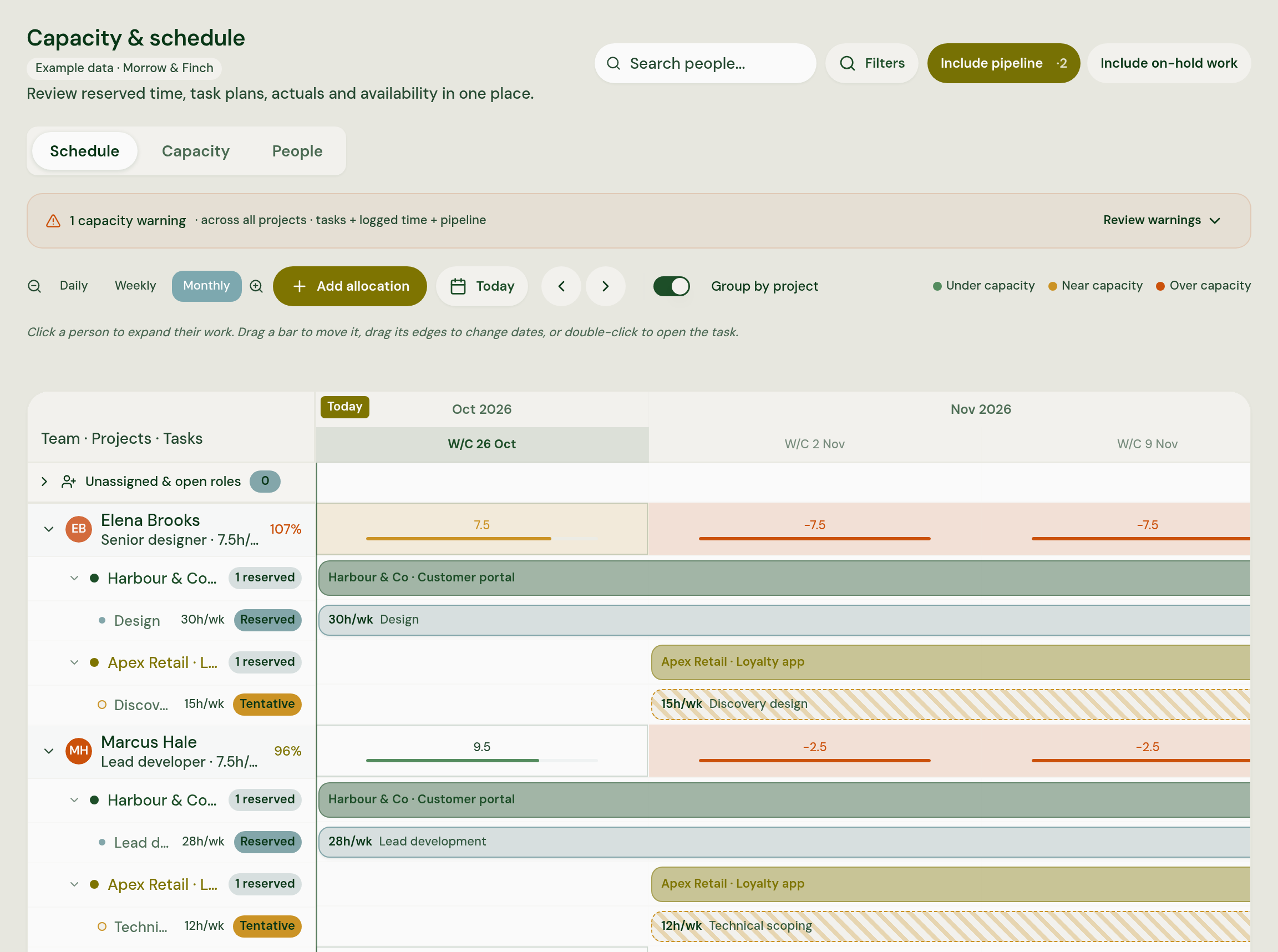
A new project is close to landing. Can your team actually take it on?
Bring pipeline and capacity planning for agencies into the same conversation. Keep opportunities alongside the people and work already committed. In Aria, Include pipeline can show draft projects and their linked tentative bookings next to confirmed work. The schedule shows proposed bookings in full, while some portfolio views can also weight opportunities by their likelihood of landing. You can review the demand before agreeing the start date.
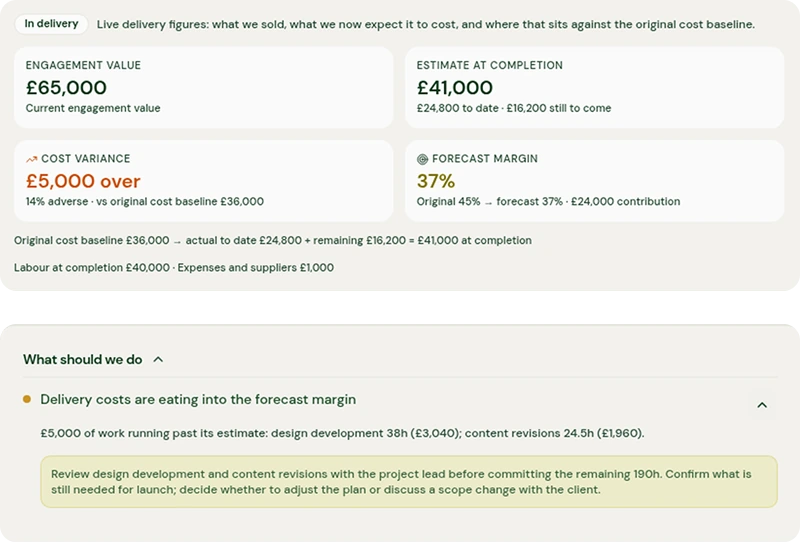
The work has changed. What does that mean for the numbers?
Projects don’t stand still. Extra revisions, longer tasks and changes to the plan affect the effort being spent. Aria brings recorded time and project financial information into the delivery conversation, so you can check the commercial picture alongside the project plan instead of treating margin as something to revisit at the end.
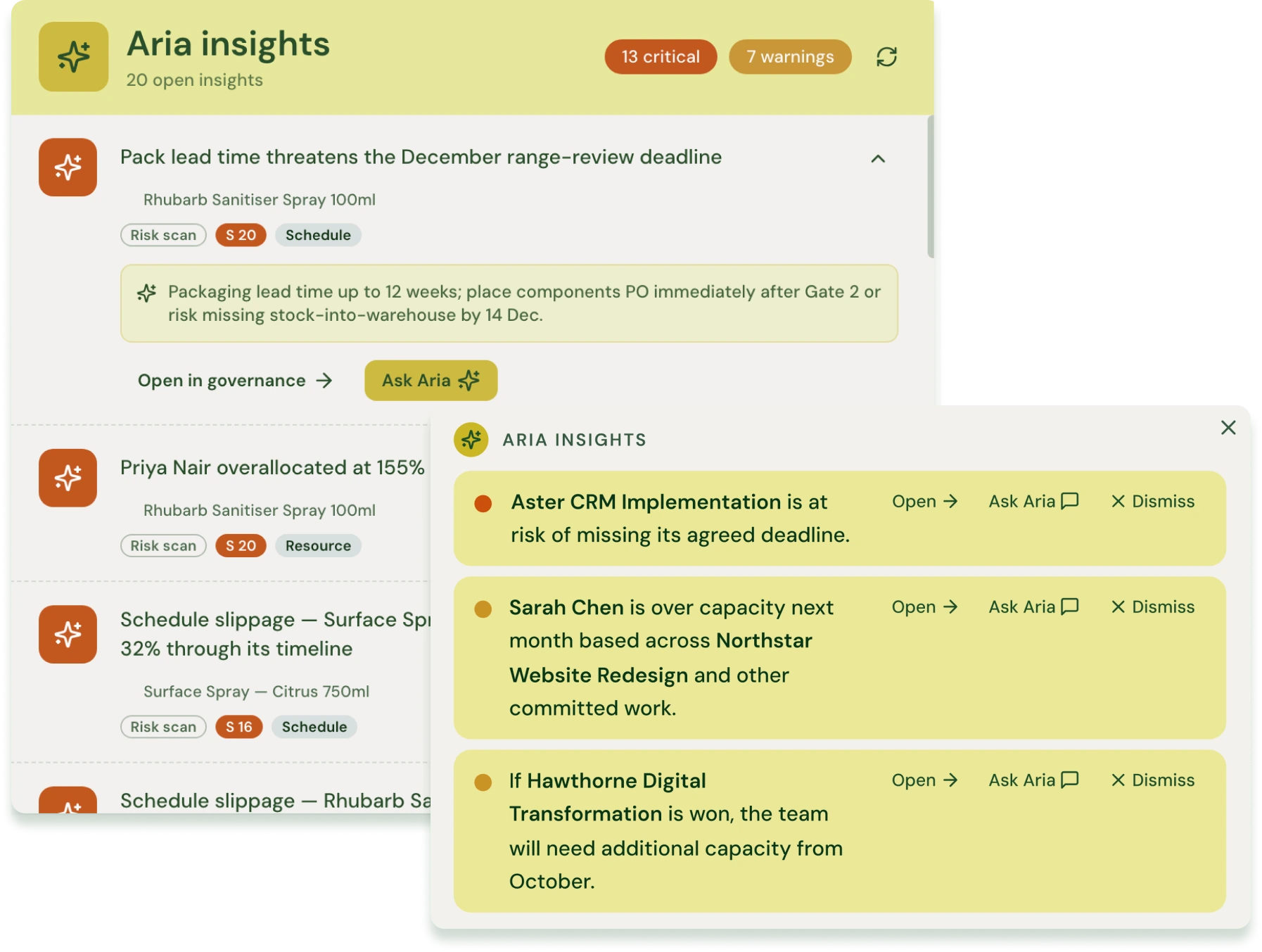
Four teams are working hard. Do you know where the pressure is moving?
See booked hours, time off and logged time across teams, with connected calendar and meeting activity added through background updates where supported. Aria can show when a person is booked beyond available hours, and Aria Assistant can help you explore who has room or what another start date might mean. You make the call with more of the pieces in front of you.

Find room to deliver more before you add headcount

“What’s huge about Aria is the proactive decision-making. It doesn’t just tell you where there’s a problem, you can ask it how to solve it. Where do we have capacity elsewhere? Can we shift this timeline to the left? How do we deliver more without adding people or sacrificing margin? For leaders making those calls every day, that's incredibly powerful.”
Vice President Product Development, ex-Amazon · Advisor to Aria
The tools that matter to operations leaders
Another dashboard isn’t much use if it leaves you with the same decisions to untangle. Here are the parts of Aria that help you do something with the picture.

Resource planning and capacity forecasting
See booked work and available hours across teams, with time off accounted for, so you can plan around pressure before the work lands on the wrong people.

Project financials
Keep project budgets, recorded effort and financial performance connected to the work behind them, so commercial questions don’t have to wait for a separate reporting exercise.

Time and reporting assistance
Record time against the work being done, giving project leads and operations teams a clearer view of actual effort, not just the original estimate.

Sales pipeline
See opportunities in the same workspace as confirmed work. For draft projects with linked tentative bookings, Include pipeline helps you assess the proposed demand alongside current commitments.

Projects and portfolio
Bring project plans and progress into a shared view. It’s easier to understand what’s happening across a busy portfolio when you’re not rebuilding it from everyone’s separate updates.

AI insights and Aria Assistant
See capacity pressure worth investigating and ask practical questions about what could change, such as who has room next month or when colleagues become available.
Keep the tools your team already uses
The answer isn’t to ask everyone to abandon the tools they already know. Aria currently integrates with Gmail, Google Calendar, Outlook, Outlook Calendar and Fireflies.ai, so supported email, calendar and meeting workflows can connect with the way projects are planned and managed.
The precise information available depends on the connection and its permissions. Recorded activity is added through supported background updates, not an instant, all-seeing feed. It’s about making the right context easier to find, alongside booked work and logged hours.

We're always adding new integrations, and we'd love to know what would make your working life easier. If there's a tool your team relies on that Aria doesn't connect with yet, get in touch and tell us what you'd like to see.
You make the call
You still make the decision. Aria just gives you a better starting point.
If a colleague is overbooked, you can review the warning and explore alternatives. Changing a start date or moving an assignment remains a human decision. Aria doesn’t make those changes just because it suggested them.
And capacity isn’t employee surveillance. Booked hours show what’s planned, not whether someone is working or idle at any particular moment.
The numbers behind it
The challenges facing operations teams are getting harder to untangle. Three independent studies help explain why the picture matters, even though none measures the impact of using Aria.
81% say projects have become more complex
In PMI’s Pulse of the Profession 2026, 81% of surveyed project professionals said project complexity had increased in recent years. It’s a global perception measure, not a prediction that every agency project will run into trouble. (Project Management Institute, 2026)
66.4% average billable utilisation
SPI Research’s 2026 Professional Services Maturity Benchmark found average employee billable utilisation of 66.4% across 509 surveyed professional services organisations in 2025, down from 68.9% the previous year. It’s a global, North America-heavy benchmark, not a target for every team. (SPI Research, 2026)
46% versus 41% gross profit
In BenchPress 2026, UK agencies with £1m+ fee income whose sales, marketing, resourcing and finance plans were fully integrated averaged 46% gross profit, compared with 41% for agencies planning mainly on instinct. This is correlation, not proof that integrated planning causes higher profit; the instinct-led agencies grew fastest. (The Wow Company, 2026)
Sources: PMI, Pulse of the Profession 2026; SPI Research, Professional Services Maturity Benchmark 2026; The Wow Company, BenchPress 2026. These are industry findings, not results achieved with Aria.
Aria versus what you use now
Most operations leads already have a way of managing this. It works, in the sense that somebody puts in the hours to make it work. Here’s where that effort tends to go.
| Decision | By hand today | With Aria |
|---|---|---|
| Across-team status | Ask for updates, compare different decks and assemble a common picture | Review projects, booked work, logged hours and time off in the same workspace |
| Resourcing | Update a capacity sheet, then discover conflicts in the meeting | Spot bookings above available hours and review alternatives while there is still time to plan |
| New business | Check the CRM against the resourcing plan once a deal looks likely | View draft projects and linked tentative bookings alongside confirmed work with Include pipeline |
| Commercial context | Bring together project hours and financial reports to explain why costs changed | Review recorded effort and project financial information alongside delivery plans |
| Who decides | You do, usually after collecting the missing pieces | You still do. Aria can show a warning or suggest an option, not make the staffing decision for you |
If capacity planning is still mostly spreadsheets, Aria vs spreadsheets goes into more detail. If you’re considering a dedicated PSA tool, see PSA software.
Good for the people doing the work, too
A useful operations picture depends on a project experience the team can keep up to date. Shared plans, recorded time and project context help people manage their work while giving you a clearer view across the business.
Making the case for Aria?
An operations decision rarely stays in operations. Here’s a useful way to show the rest of the business what they’d get from Aria.
For your CEO or founder
A clearer view of delivery, capacity and the cost of growth, without relying on you to join up every answer by hand.
See Aria for founders and CEOsFor your CFO or finance lead
Project costs, recorded time and delivery decisions belong in the same conversation. See the financial side of a connected operation.
See Aria for CFOs and finance leadersFor your delivery team
Shared project plans, clearer priorities and a simpler way to keep the right people in the picture.
See Aria for delivery teamsCommon questions
See what Aria could change for your operation
Bring us the delivery question that keeps coming back, whether it’s who can take on the next project, why the hours are climbing or where the latest change has left everyone else. We’ll show you the parts of Aria that matter to that decision.
14 days to explore Aria · No credit card required · Cancel anytime
Read more
Most agencies track new work in one place and how busy the team is in another, so nobody sees the two collide until people are already overcommitted. This piece explains why capacity planning across projects gets harder as you grow, and how to see resourcing pressure while you can still do something about it.
Michael Gold · · 12 min read
OperationsCapacity planningWhen a project goes wrong, the warning signs have usually been there for weeks, spread across different tools and only joined up when someone pulls a status report together by hand. Michael Gold explains why that keeps happening, and why even good delivery tools rarely make it easy to see what needs attention while there's still time to act. You'll also find out what it means for your role, and where to go next if you want to get into the detail.
Michael Gold · · 12 min read
Founders and CEOsHeads of DeliveryOperationsFinance leadersProject managersDelivery consultantsDelivery teamsMargin and profitabilityStatus and reporting