
PSA (professional services automation) software helps agencies run projects, people, time, budgets and billing in one place. Aria is AI-native agency management and PSA software for agencies and consultancy firms. It brings recorded projects, people, time and money together, then does the looking for you: it shows how a change in one place affects everything else, explains what needs attention and suggests what to do while there's still time to act. The decision stays with you.
For a plain explanation of the category, read What is PSA software?.
Most agencies start looking at PSA software for a good reason. Timesheets are patchy, invoicing takes longer than it should or nobody's quite sure whether a project made money until it's finished. A good PSA tool will help with a lot of that. This page sets out what PSA software does, where agencies still get caught out and what Aria does differently.
On this page
What to assess in PSA software
PSA tools vary a lot. The left-hand column sets out questions to ask of any product, including Aria; the right-hand column explains Aria's approach.
| Area | What to assess | Aria |
|---|---|---|
| Core purpose | Can it connect projects, people, time, budgets and billing in the workflows you need? | Connects projects, people, time and money, and shows what needs attention while there's still time to act |
| What it covers | Which project, time, budget, resourcing and invoicing workflows does it support? | Recorded projects, time, costs, booked capacity, pipeline views, delivery forecasts and shared client progress |
| Spotting problems | What does it flag proactively, how does it explain the warning and what can you configure? | Aria looks across the picture for you, spots what's slipping and explains why |
| Joining the dots | Can it explain how a change affects delivery, people and margin, and suggest next steps? | Shows the knock-on effect for delivery, people and margin and recommends the next move |
| Day-to-day use | Can your team find what it needs and keep the records current? | Specifically designed with ease of use in mind, because a tool only helps if people use it. Aria's interface is easy to navigate and simple to pick up. |
| Getting started | What setup and migration work is needed, and who will help? | Your team can set it up itself, starting from recorded projects, estimates and bookings, with optional expert help from Gold Strategic Delivery |
| Who decides | Who reviews recommendations and approves changes? | You do. Aria recommends; the person accountable decides what happens next |
| Best for | Which tool fits your delivery, billing, reporting and adoption needs? | Agencies that want a tool that's easy to set up and joins the dots for them, so they stay in control without the legwork |
PSA software in brief
PSA stands for professional services automation. PSA software is built for businesses that sell their people's time, such as agencies and consultancy firms. It connects projects, people, time, budgets and invoices, helping teams plan work, record effort and manage the commercial side of delivery. Product scope varies, including expenses, reporting and forecasting.
It does that job well. A good PSA tool gets timesheets into one place, makes billing less painful and shows how much of people's time is going on client work, known as utilisation. If your agency is still invoicing from a spreadsheet and a pile of emails, professional services automation software is a real step up, and plenty of agencies run it well.
Modern PSA tools go further, with forecasting, profitability reporting and, increasingly, AI assistants. Aria is one of them. If you're choosing a PSA, the useful question is less what each one covers, since most cover the basics, and more how easily your team will see what needs attention and act on it.
Where do agencies still get caught out?
Mostly in the timing. Any tool, PSA or not, is only as current as the information people have put into it, and in most agencies that information arrives late. Time gets logged at the end of the week, or the end of the month. A client asks for a little extra on a call and nobody updates the budget. Someone works late to hit a deadline, and it doesn't show anywhere until their timesheet goes in.
And many agencies don't run everything in one place. The plan sits in a project tool, time in a timesheet tool and the client conversations in email and meeting notes. Each system holds part of the truth, but someone still has to join it all together, usually a project manager rebuilding status by hand before a meeting. In Wellingtone's 2026 survey, 72% of project professionals said they spend half a day or more each month collating status reports (Wellingtone, 2026).
Good PSA tools have dashboards, alerts and, increasingly, AI features, and they help. What often stays hard is seeing why something changed and what else it affects, without digging through several screens.
That delay matters because overruns are common. More than a quarter of projects miss their budget and more than a third miss their schedule, according to PMI's global survey of project professionals (PMI, 2025). Spotted while the work is still going on, an overrun is a conversation about scope, staffing or the plan. Spotted at month-end, it's margin that has already gone.
What does Aria do differently?
Aria is a PSA, so the basics are there: project records, time, approved expenses and booked capacity, with pipeline views and financial forecasts. A forecast can account for both costs recorded so far and remaining estimates or bookings.
You can upload your Statement of Work and Aria proposes a delivery plan for you to review, with the agreed scope still attached once you approve it. If the plan drifts from what was sold, Aria flags it.
Connected email, calendar and meeting records add context through background updates. With an agreed scope recorded, Aria can flag potential additions or work outside the recorded deliverables. Someone still needs to check what was agreed and whether a change is billable.
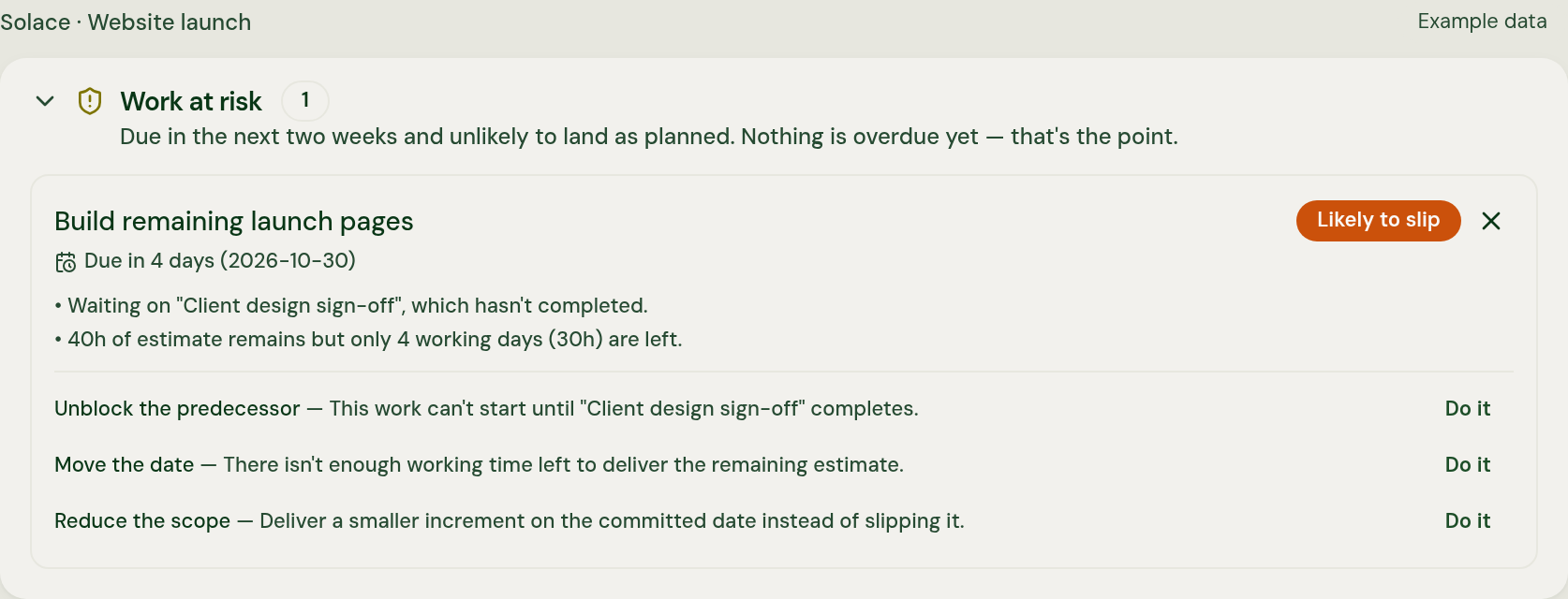
Then Aria does the looking for you. It spots what's slipping, shows the knock-on effect for delivery, people and margin and explains why a project has been flagged. It recommends the next move while there's still time to make it, and because the picture is current, you can act on it rather than just report it.
It's also built to be easy to pick up. A PSA only helps if people keep it up to date, so Aria aims to feel friendly and familiar rather than another system to learn.
Your product is well thought out and intuitive to use compared to competitors on the market. The design feels natural and different from everyone else, particularly the AI elements. While other tools can do cool things, they're often horrible to use and difficult to navigate – yours avoids that problem entirely.
Founder, WorkFlow Mind
Aria is software your team can set up and run itself. If you'd also like expert help designing how delivery should run, or getting a bigger team set up, Gold Strategic Delivery, a separate delivery consultancy founded by our CEO Michael Gold, offers that as an optional extra.
Does Aria make decisions for you?
No. Aria recommends, you stay in control. It can flag what's slipping and suggest a next move, but the decision stays with the person accountable for the work. On its own, Aria doesn't submit timesheets, send anything to a client, move people between projects or make commercial calls.
Because Aria explains why it has flagged something, you can weigh up the recommendation, change it or set it aside. You stay the one who talks to the client, moves people around or changes the plan.
It isn't there to watch your team either. It's built to help the people running client work see trouble coming, not to keep tabs on the people doing it.
When does Aria make the biggest difference?
When the joining up is still being done by hand. Aria helps most if:
- you run delivery across a project tool, timesheets and spreadsheets, and someone has to join it all up by hand
- you have a PSA, but the team finds it hard to use or doesn't keep it up to date
- one person holds the whole picture in their head, and it's starting to show
- you find out about overruns at month-end rather than while you can still do something about them
Already running a PSA you're happy with? The question worth asking is whether it shows you what needs attention in time to act. Bring a real project to a walkthrough and see what Aria would have flagged.
Even with software, someone still needs to record time, maintain estimates and check what was agreed with the client. Aria's calculations and warnings help you review that record; they don't remove the need for an owner.
And if your system is still mostly spreadsheets, start with Aria vs spreadsheets.
What should you look for in agency management software?
If you're comparing agency management software, most tools will cover the basics: time, budgets, resourcing and invoices. The useful questions come after that. These are the ones we'd ask in any demo, including ours:
- How current is the picture? Does it update as the work happens, or when someone runs a report?
- Does it join things up? Can you see how new work in the pipeline affects who's available, and how that affects margin?
- When it flags something, does it say why? And can it show you what else that change will affect?
- Who makes the call? Does it ever act on its own, or does it leave the decision with you?
- Will your team use it? A tool that feels like it's watching people won't get the honest data it needs.
If we had to pick one test, it would be this: does it tell you what needs attention in time to do something about it? Michael Gold, our CEO and co-founder, makes the same point in Why your agency has the information but still misses the warning signs: test whether a tool tells you what needs attention in time to act. For the bigger picture of why agencies so often find out late, see Why agencies still find out too late.
What about spreadsheets or a fractional COO?
Many agencies start with a project tool, a spreadsheet and someone joining the picture together by hand. Moving to PSA software changes the tools, but delivery still needs people to lead it. A delivery lead, COO or consultant will often introduce and manage the software, help the team adopt it and lead changes to how work gets done. They also support the people managing and delivering client work. Aria reduces the admin around that work and gives them clearer information to act on; their leadership remains essential.
We go through both in Aria vs spreadsheets and Aria vs a fractional COO or delivery consultant, and you can see every comparison on our compare page.